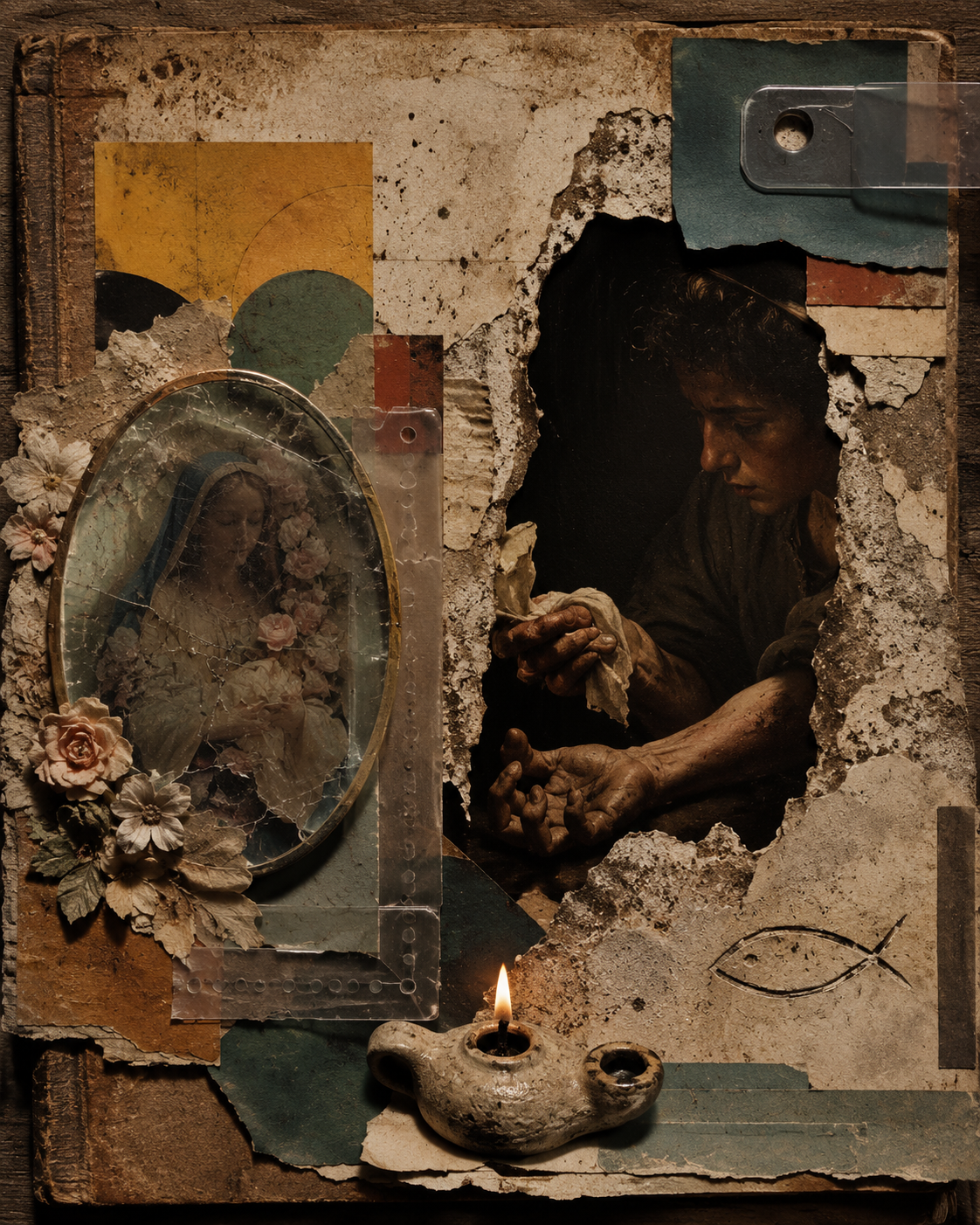
TL;DR / Answer Box Weak Christian art tends to substitute emotional reassurance for honest truth-telling. The problem isn't sincerity — it's the confusion of aims. Art made primarily to comfort rather than confront loses the very quality that made the greatest sacred art powerful: the refusal to lie about what it costs to believe.
The question is uncomfortable to ask out loud, especially in church. But it lives in a lot of people who love both God and art, and it deserves an honest answer rather than reassurance that it's fine, everything's fine.
Why does so much Christian art feel like it's lying to you?
Start with Caravaggio.
In 1599, Cardinal Francesco Maria Del Monte commissioned Caravaggio to paint the life of Saint Matthew for the Contarelli Chapel in Rome. The painting Caravaggio delivered — the Calling of Saint Matthew — shows Matthew and his companions at a table, caught in the middle of ordinary life. A shaft of light falls through a dark room. One figure turns toward the door where Christ and Peter stand.
And Matthew's feet, in the foreground? Dirty. His companions' clothing? Working men's. The tax collector is recognizable as a tax collector — not idealized, not softened, not made to look like he's already a saint. He looks like someone interrupted in the middle of being exactly who he is.
The Counter-Reformation hierarchy found it scandalous. The church wanted saints who looked holy.
Caravaggio gave them saints who looked human, and left the light to do the theological work.
What kitsch is — and what it does
The word kitsch comes from German — roughly "to put together sloppily," later associated with cheap, sentimental art designed to produce easy emotion. The critic Hermann Broch called it "the absolute denial of shit" — a phrase that, in its unflinching directness, identifies exactly what kitsch removes: anything uncomfortable, unresolved, or costly.
The operative move in kitsch is reassurance. It takes a difficult subject and smooths it until it produces comfort. The grief is named but quickly resolved. The doubt is acknowledged and immediately answered. The hardship is present but leads, inevitably, to a lesson and a bow.
This is not a problem of sincerity. The maker of kitsch is often deeply sincere. The problem is a confusion of aims: art made primarily to reassure cannot also be fully honest — and art that is not honest cannot finally be beautiful, in the way the greatest sacred art has always been beautiful.
Why the church's greatest art came from the hardest seasons
The first Christian artists painted underground.
In the Roman catacombs — the burial tunnels beneath the city where Christians gathered secretly under threat of persecution — they painted the Good Shepherd: a small man carrying a lamb, tender, particular, unimpressive. Not a triumphant king. A shepherd. They painted Daniel in the lions' den, Jonah under the vine, the bread and the fish. Art made by people who could be killed for their faith.
None of it was made to sell. None of it was made to reassure a market. It was made because the people making it believed it, and it cost them something, and the belief had to go somewhere.
Bach wrote his cantatas under institutional pressure, served capricious employers, buried four of his children, and marked every score with Soli Deo Gloria — to God alone the glory. Not as a branding exercise. As a statement of orientation. The music is that honest.
Caravaggio's realism was controversial because it refused to spiritualize the Incarnation. The Word became flesh — specifically, materially, with dirty feet in a dark room. The shock was the theology. Softening it would have been a lie.
The hymn "It Is Well with My Soul" was written by Horatio Spafford in the immediate aftermath of his daughters' deaths in a shipwreck. He wrote it while sailing over the spot where they went down. It is not a song about having the right feelings. It is a song about choosing to hold onto truth when the feelings are devastating. That is why it has outlasted every easier hymn written in the same era.
The commercial turn — and what it costs
By the latter half of the twentieth century, "Christian" had become a marketing category. A parallel market emerged — Christian music, Christian movies, Christian publishing — serving an audience with specific expectations. The audience wanted to feel encouraged. The market learned to provide what the audience wanted.
This is not a conspiracy. It is what markets do. But the feedback loop has a cost: art shaped primarily by what will sell to a specific cultural audience tends toward reassurance, because reassurance sells. The difficult, the unresolved, the honestly costly — these are harder to market and harder to sit with.
Dorothy Sayers, writing in 1942, named the artist's first obligation: not to her religion, not to her audience, but to the work itself. To make it well. To serve its own demands. The failure mode she diagnosed in Christian art was treating the art as a vehicle for a message — which reduced it to propaganda, however sincere.
Propaganda reassures. Art confronts. The best sacred art has always done both at once — which is what makes it hard.
The question underneath the embarrassment
If Christian art sometimes embarrasses you — if you find yourself wincing at the easy arc, the too-clean resolution, the music that sounds like it's trying to sell you something — that embarrassment is worth trusting.
It is the longing for honesty. It is the same instinct that made people weep over Bach, and made the catacombs artists paint what they painted, and made Caravaggio leave the dirt on the feet.
The embarrassment isn't contempt for sincere makers. It's recognition that the faith deserves more than reassurance. The faith can hold what it actually costs — death and grief and doubt and the daily difficulty of believing — and art that holds those things is not less Christian. It is more.
The call to make excellent work, "filled with the Spirit of God, with skill, with intelligence, with knowledge, and with all craftsmanship" (Exodus 31:3), was not a call to make comfortable work. It was a call to make true work. The two are often different.
The Weekly Offering carries one piece like this to your inbox each week — something that takes faith and craft seriously, at the same time.