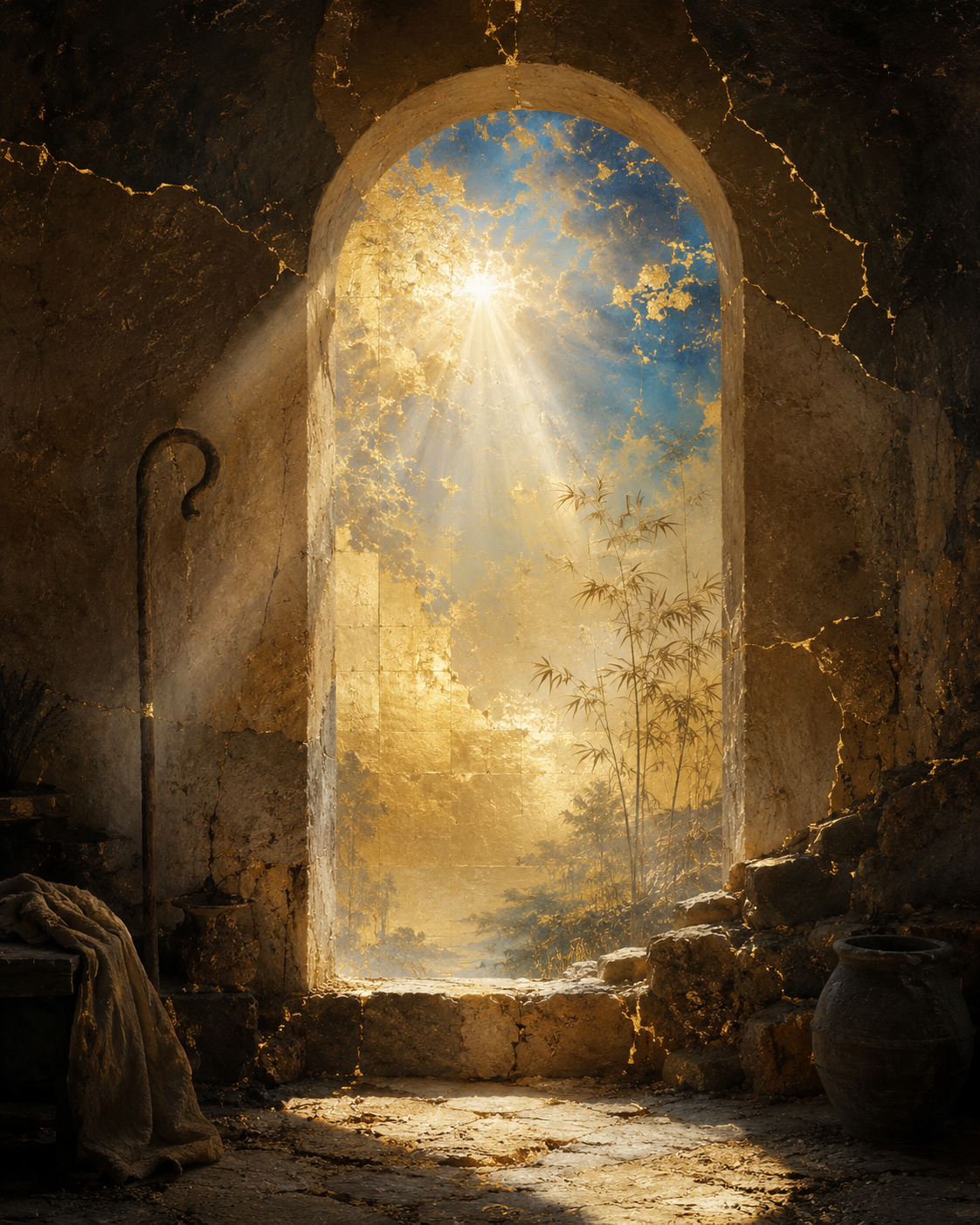
TL;DR / Answer Box Sacred art is defined not by its subject, its style, or whether it was made for a church, but by its direction — where it points and what it forms in the viewer. Art becomes sacred when it turns the eye toward God rather than toward itself or its maker. This principle holds from the catacombs to the present.
The question has been asked in every century the church has made art. Sometimes it surfaces as does this painting belong in a church? Sometimes as can a secular song be sacred? Sometimes as why does this feel holy when that doesn't?
The question underneath all of them is the same one: what makes a piece of art sacred?
The first answer — and why it falls short
Most people reach for subject matter. Sacred art depicts sacred subjects: Christ, the saints, Scripture stories, the cross. Secular art depicts everything else.
But this runs into trouble quickly. A painting of the Annunciation can be kitsch — saccharine, soft, designed to reassure rather than to confront. A painting of a dead field can be an act of lament that opens a person to God. Which is the sacred work?
The second answer is intention — the artist made it for God; therefore it is sacred. But intention alone doesn't account for what the finished work does in the viewer's soul. A genuinely well-made secular landscape can awaken the same sense of the infinite that a badly made altarpiece fails to touch.
Neither subject nor intention alone is sufficient. Which points to the third, older, more demanding answer.
Direction
The early church had a working distinction for what separates an icon from an idol: direction of attention. An idol turns the worshiper's attention to the object itself and stops there. An icon is meant to be transparent — to turn the attention through the image toward what it represents.
This is the principle: sacred art functions as a window, not a mirror. It turns the eye outward and upward — toward God, toward truth, toward the neighbor — rather than back toward the maker or the viewer.
This is why Caravaggio's saints with dirty feet still feel sacred four hundred years later, even though the Counter-Reformation hierarchy found them scandalous: those dirty feet are true. They refuse to lie about what it means for God to take on human form. They turn the eye toward the Incarnation — messy, material, particular — rather than away from it. The dirt is the theology.
And it's why a technically accomplished altarpiece can feel hollow: because the skill is saying look at me, not look through me.
Five examples across five centuries
The Catacomb of Priscilla, Rome (c. 200–400 CE). The earliest Christians, painting underground, chose the Good Shepherd — not a triumphant figure, but a small man carrying a lamb. Direction: toward the tender, particular care of God.
Cimabue's Maestà (c. 1285). A gold ground. No landscape. The Virgin and Child set outside of time, in a symbolic space that says: this is not a moment in history; this is an eternal reality. Direction: outside the frame of the world.
Caravaggio, The Calling of Saint Matthew (1600). A shaft of light in a dark room. A tax collector who doesn't yet know he's being called. Direction: toward the moment before transformation, held still.
J.S. Bach, Mass in B Minor (1749). Music that exhausted its composer and outlasted every king he served. Every score carries the marking Soli Deo Gloria: to God alone the glory. Direction: explicit, structural, defiant.
Makoto Fujimura, Silence and Beauty (2016). A contemporary artist working in Nihonga — Japanese mineral pigments — to engage the persecution of the early Japanese church. Direction: toward suffering held in beauty, toward the question of what faith looks like when it costs everything.
Five centuries. Five styles. Five traditions — Catholic, Protestant, contemporary. The through-line isn't subject matter. It isn't style. It's the direction the work is facing.
The question you bring to any piece of art
Not is this sacred in subject? but where is it pointing?
And the question you bring to your own work, if you make things, is the same one: is this turning something outward — toward truth, toward beauty, toward the neighbor, toward God — or is it turning inward, toward my name?
Sacred is a direction, not a style. You can make sacred work in any medium, in any genre, with any palette. And you can make hollow work in a cathedral, on a Sunday, with the best intentions.
The test isn't the subject. It's the window.
The Weekly Offering carries one piece like this to your inbox each week — sourced, beautiful, quietly.